The Fine Was Paid—and Then He Passed the Hat
Hey there,
Ever since we had a mercy discussion in one of our Wednesday night studies it’s been on my heart. I’ve heard this story for years in one form or another. A hungry person. A loaf of bread. A judge who wouldn’t ignore the law—and wouldn’t ignore a hurting family either. I want to tell it the way it might sound if it happened on our streets.
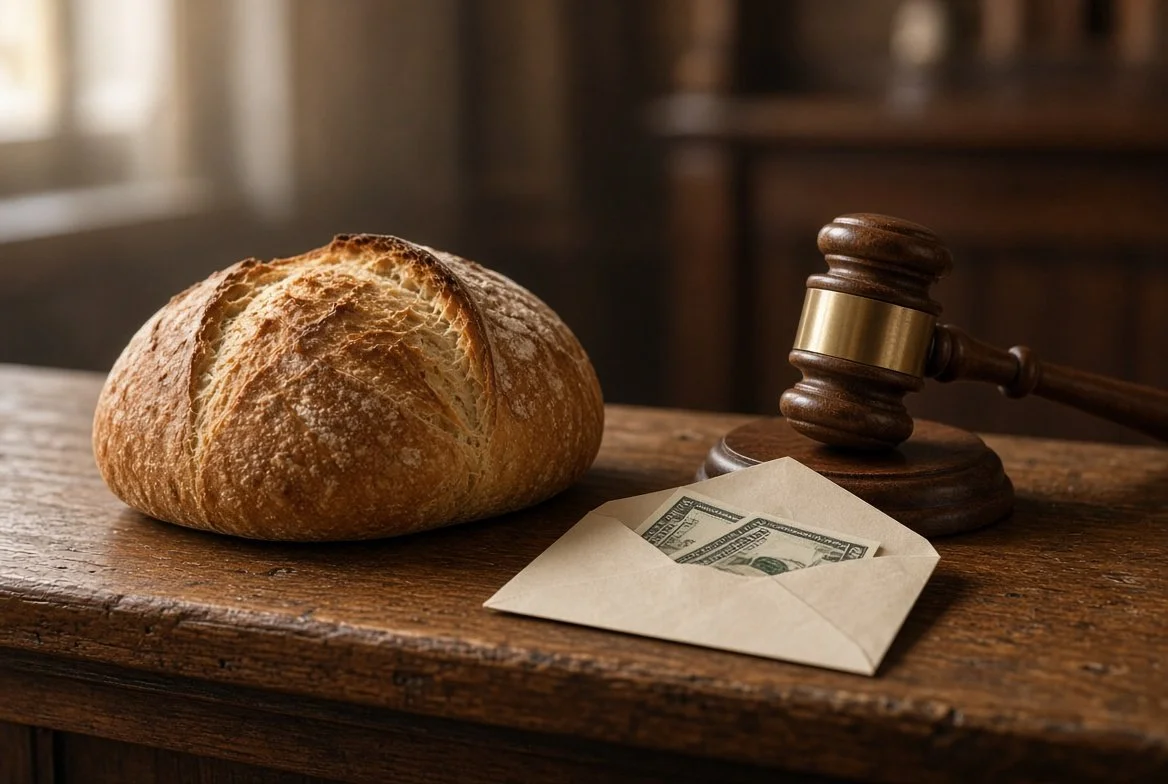
A man gets caught on store cameras sliding a loaf of bread, a gallon of milk, and a jar of peanut butter into a backpack. He’s charged with shoplifting. In municipal court nobody’s arguing the facts. He’s been laid off. Rent’s late. The kids are hungry. He’s applied for help and waited. Then he took food.
The judge listens and says, “I believe you. I also have a job to do. The law doesn’t vanish because life got hard. You stole. There’s a two-hundred-dollar fine.”
The room goes quiet. He doesn’t have it.
Then the judge reaches into her own wallet, counts out two hundred dollars, and lays it on the clerk’s desk. “The fine’s paid,” she says. “Paid in full. I’m also remitting it. You can keep this money. It’s yours.”
She’s not done.
“I’m fining every person in this room twenty dollars,” she says, “for living in a town where a parent has to steal groceries so children can eat. Bailiff, collect it. Give every dollar to him.”
Phones come out. Cash comes out. Even the store manager who pressed charges puts in twenty dollars, face red. When the envelope comes back, the man walks out with the original two hundred plus several hundred more—and a list of numbers for a food pantry, a job clinic, and a church that will meet him that afternoon.
Justice didn’t get canceled. The debt got named and paid. Mercy meant he didn’t carry the penalty himself. Grace meant he left with more than a clean slate. He left with help he hadn’t earned.
What this tells us about God.
I think we sometimes use these words like they all mean the same thing. Scripture holds them together, and I think we need all three.
Justice is God telling the truth about sin. “The wages of sin is death, but the free gift of God is eternal life in Christ Jesus our Lord” (Romans 6:23). A holy God can’t shrug. If He did, He wouldn’t be just. In the story the judge doesn’t pretend theft is fine. In the gospel God doesn’t pretend our rebellion is a mix-up.
Mercy is not getting the punishment we deserve. The fine is real; someone else pays it. Paul says God presented Christ “as a sacrifice of atonement… to demonstrate his righteousness… so as to be just and the one who justifies those who have faith in Jesus” (Romans 3:25–26). At the cross God isn’t ignoring the law. He’s satisfying it in our place. On Sunday, we sang the song Before the Throne of God Above. In it my favorite line:
Because the Sinless Savior died, My sinful soul is counted free. For God the Just was satisfied, To look on Him and pardon me.
Grace is getting what we could never deserve. That man didn’t only walk free. He walked out funded. “But God, being rich in mercy, because of the great love with which he loved us, even when we were dead in our trespasses, made us alive together with Christ—by grace you have been saved… so that in the coming ages he might show the immeasurable riches of his grace” (Ephesians 2:4–7). Forgiveness is mercy. Adoption, the Spirit, daily bread, a future with Him—that’s grace stacked on top.
Justice says the bill is due.
Mercy says we won’t pay it.
Grace says sit down; the Father’s already set a table.
Where this lands for us.
I don’t need a lighter sentence. I need a Substitute. Hebrews says we can “approach God’s throne of grace with confidence, so that we may receive mercy and find grace to help us in our time of need” (Hebrews 4:16). We don’t come with a better story. We come empty. The payment’s already on the desk.
And we can receive more than pardon. A lot of us live like the gospel only cancels a fine. Jesus said, “I came that they may have life and have it abundantly” (John 10:10). God also puts provision in our hands—His presence, His people, His promises for Tuesday afternoon. We can ask Him for the extra in the envelope, not just the closed case.
We can become a small version of that courtroom. We can’t pay anybody’s sin debt. We can refuse to pretend harm is fine. We can refuse to crush someone who’s repentant. “Be kind to one another, tenderhearted, forgiving one another, as God in Christ forgave you” (Ephesians 4:32). And we can refuse to stop at “you’re off the hook” when we could also help them eat, work, and belong. “If a brother or sister is poorly clothed and lacking in daily food, and one of you says to them, ‘Go in peace, be warmed and filled,’ without giving them the things needed for the body, what good is that?” (James 2:15–16). That store manager who put in twenty dollars is part of the story too.
Look around our town. The original story ends with a rebuke to the whole room. Micah asks what the Lord requires of us: “to do justice, and to love kindness, and to walk humbly with your God” (Micah 6:8). If we sing about grace and never notice hungry neighbors, we’re only humming half the hymn. Mercy and grace that never leave the church haven’t yet understood the Judge who paid—and then passed the hat.
The law still stands. The fine is paid. And the Father isn’t content to send us out even. “He who did not spare his own Son but gave him up for us all, how will he not also with him graciously give us all things?” (Romans 8:32). He paid the debt—and then He put something in our hands.
That’s the mercy I keep coming back to—not a shrug, but a paid debt and an open hand. One of my favorite songs about mercy is the one below.
I hope this message blesses you this week!
Charlie