The Bible in the Garden
Hey there,
If you’re reading this on your phone, your laptop, or that Bible that’s been sitting on the table all week, you’re holding something a lot of our brothers and sisters would risk their lives just to touch.
And I don’t mean that in a “churchy illustration” kind of way. I mean it for real.
I’ve been thinking this past week about how easy it is for us to take the Bible for granted. If you live in a place like a lot of us do in the West, you can buy one, download one, quote it out loud, and leave it lying around the house. Nobody’s coming to dig up your yard over it. That’s a gift. It’s also a gift we can stop noticing.
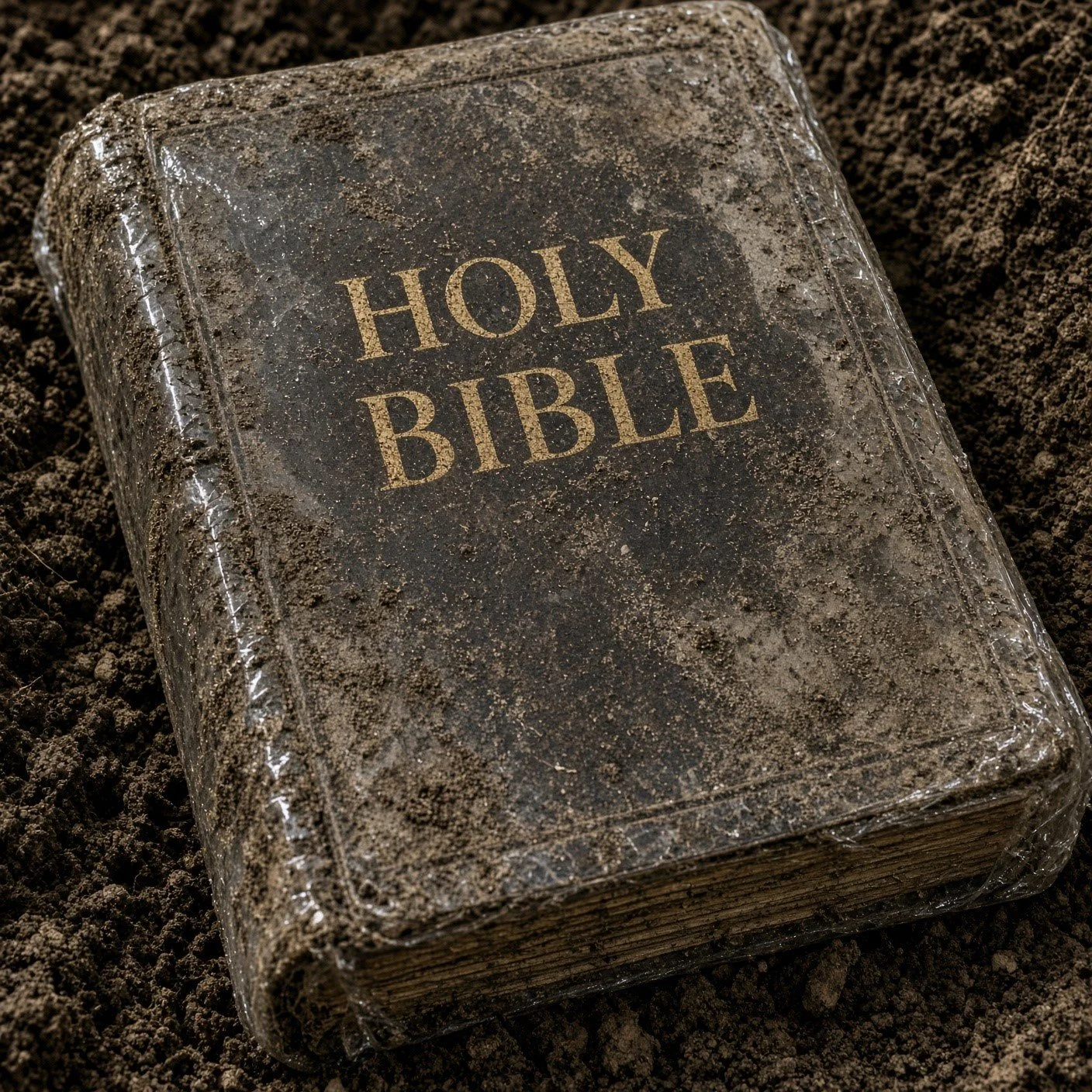
A book buried in the dirt
In preparation for our Young Adult class this past Sunday I came across a story from Open Doors about a young girl in North Korea. They call her Ji Ho. That’s not her real name. They change names and sometimes blend details so people still living there don’t get hurt.
One day the police tore through her family’s little house. They dumped drawers and destroyed the inside. Then they went outside and started digging in the garden.
They were looking for proof that her dad was a Christian.
They found it.
“The men found a Bible wrapped in plastic, buried in the garden,” Ji Ho said. “My father and I sobbed. In that moment, we knew we’d never see each other again.”
They dragged her dad out of the house. She never saw him again. She doesn’t even know what happened to him. She grew up alone.
In North Korea, owning a Bible isn’t a personal faith decision. It’s treated like a crime against the country. Open Doors has North Korea at No. 1 again on the 2026 World Watch List. If they find out you’re a Christian, you can end up in a labor camp with almost no hope of getting out. Or worse. Your family can pay the same price. Open Doors thinks there are about 400,000 secret believers there. They whisper. They hide. They don’t get to be open about Jesus. (opendoors.org.au)
Years later, Ji Ho was hungry. Like, really hungry. She turned on her dad’s old transistor radio hoping to hear something about food. Instead she heard a voice reading the words of Jesus: “You are the salt of the earth.”
She almost dropped her tea. That sounded like the things her dad used to tell her from that buried book. She became convinced this Jesus was the Teacher he’d been trying to tell her about. She gave her life to Him.
She still has to keep it quiet. “I hope that one day I can meet another follower of Jesus,” she said. “In the meantime, I will continue to listen to the radio and follow Jesus. I want to continue to be salt and light.” (opendoors.org.za)
A little girl watched men pull the Word of God out of the dirt and take her father with it. And the Word still found her.
What we hold so casually
That story shouldn’t just make us sad. It should make us look at our own Bibles a little differently.
If a plastic-wrapped Bible in a garden was worth a father’s life, what does that say about the one we haven’t opened this week?
If a starving girl leaned into static just to catch a few verses, what does that say about the ones we scroll past?
I’m grateful we can own Scripture without hiding it in the yard. That freedom isn’t because we’re braver than Ji Ho. It’s just the place God has us right now. The danger isn’t that the Bible is easy to get. The danger is that easy turns into “eh, I’ll get to it later.”
Hebrews 13:3 says to remember people in prison like we’re in there with them. That’s not just “pray for those poor folks over there.” It’s also, don’t treat lightly what they’d die to read.
It’s bigger than one garden
North Korea is the sharpest picture. It’s not the only one.
Open Doors says about 388 million Christians—roughly one in seven in the world—face high levels of persecution or discrimination for following Jesus. (opendoorsus.org)
A 2025 Bible Access List found that about 100 million Christians in 88 countries can’t freely read their own copy of the Bible in their own language without a real fight. There are 15 countries with “extreme” restrictions, including Somalia, Afghanistan, Yemen, North Korea, and Mauritania, and 18 more with “severe” ones. In some places you can’t legally print it, bring it in, or even keep it. In others it’s technically legal, but it’s dangerous, tightly controlled, or just really hard to get. (christianitytoday.com)
And legality isn’t the whole story. You can live in a country where the Bible exists and still never hold one because of poverty, war, fear, or because it isn’t in your language yet.
Translation is both encouraging and unfinished. As of September 2026, Wycliffe says:
807 languages have a full Bible
1,844 more have a New Testament
1,519 have portions
about 3,224 still have no Scripture at all
about 1 in 5 people are still waiting for the Bible in their language
United Bible Societies says by early 2026 around 6.2 billion people had a full Bible available in a language they can use, while about 123 million still had none. God’s doing a lot. There’s still a lot left. (wycliffe.org.uk)
So the question isn’t only, “Is the Bible banned?” It’s also: Can this person own it? Read it without getting arrested? Hear it in the language they dream in? Get even one page?
Ji Ho’s garden is one picture of that hunger.
So what do we do?
This doesn’t have to get complicated.
Open it like it cost something.
Not because you should feel guilty. Because it’s precious. Read a little slower this week. Memorize one verse. Read it out loud. If a girl in the dark held onto “You are the salt of the earth,” we can stop treating those words like background noise.
Remember people like we’re in it with them.
Don’t just pray “for the persecuted church.” Pray for North Korea. Pray for kids who lost a parent over a hidden book. Pray for people listening to radios after midnight.
Use the freedom you’ve got.
Talk about Jesus while you still can do that without a knock on the door. Read Scripture with your kids while they can hold a printed copy in the living room. The cost for a lot of us is awkwardness, not a labor camp. Let’s not waste that.
Help get the Word to people who can’t reach it.
Support ministries that translate, print, broadcast, and quietly get Scripture into hard places. A radio program or one New Testament can be somebody else’s buried treasure coming back into the light.
The same Jesus who found Ji Ho through static is still speaking. The question for those of us with an open Bible is whether we’re listening—and whether we’ll remember the people who have to hide the Book we get to leave on the table.
“Your word is a lamp to my feet and a light to my path.” (Psalm 119:105)
Lord, forgive us for getting bored with what other people bury in gardens. Help us love Your Word. Strengthen the ones who risk everything to read it. And make us salt and light while we still have the chance. In the name of our Lord and Savior, Jesus the Christ, Amen.
~ Charlie
Organizations worth knowing
Open Doors — Serves persecuted Christians and publishes the World Watch List. This is where Ji Ho’s story comes from.
opendoors.org · opendoorsus.org · opendoorsuk.orgThe Voice of the Martyrs — Helps believers in restricted nations and works to get Scripture into dangerous places.
persecution.comWycliffe Bible Translators — Bible translation for languages that still don’t have Scripture.
wycliffe.orgUnited Bible Societies — National Bible Societies translating and getting Scripture out.
unitedbiblesocieties.orgBible Access List — Tracks where the Bible is restricted or just really hard to get.
bibleaccesslist.orgInternational Christian Concern — Advocacy and help for persecuted believers.
persecution.orgBarnabas Aid — Support for Christians facing pressure and violence.
barnabasaid.org