Hey there,
The Mayflower didn’t leave in triumph. It left tired.
They’d already tried once with a second ship, the Speedwell, and she’d leaked so badly they had to turn back, again. People unpacked, packed again, argued, prayed, and wondered if this was still the Lord’s idea. In mid-September 1620 they finally sailed from Plymouth, England—September 6 on their calendar, the 16th on ours—about 102 passengers packed into a ship that was never meant to carry that many souls that far.
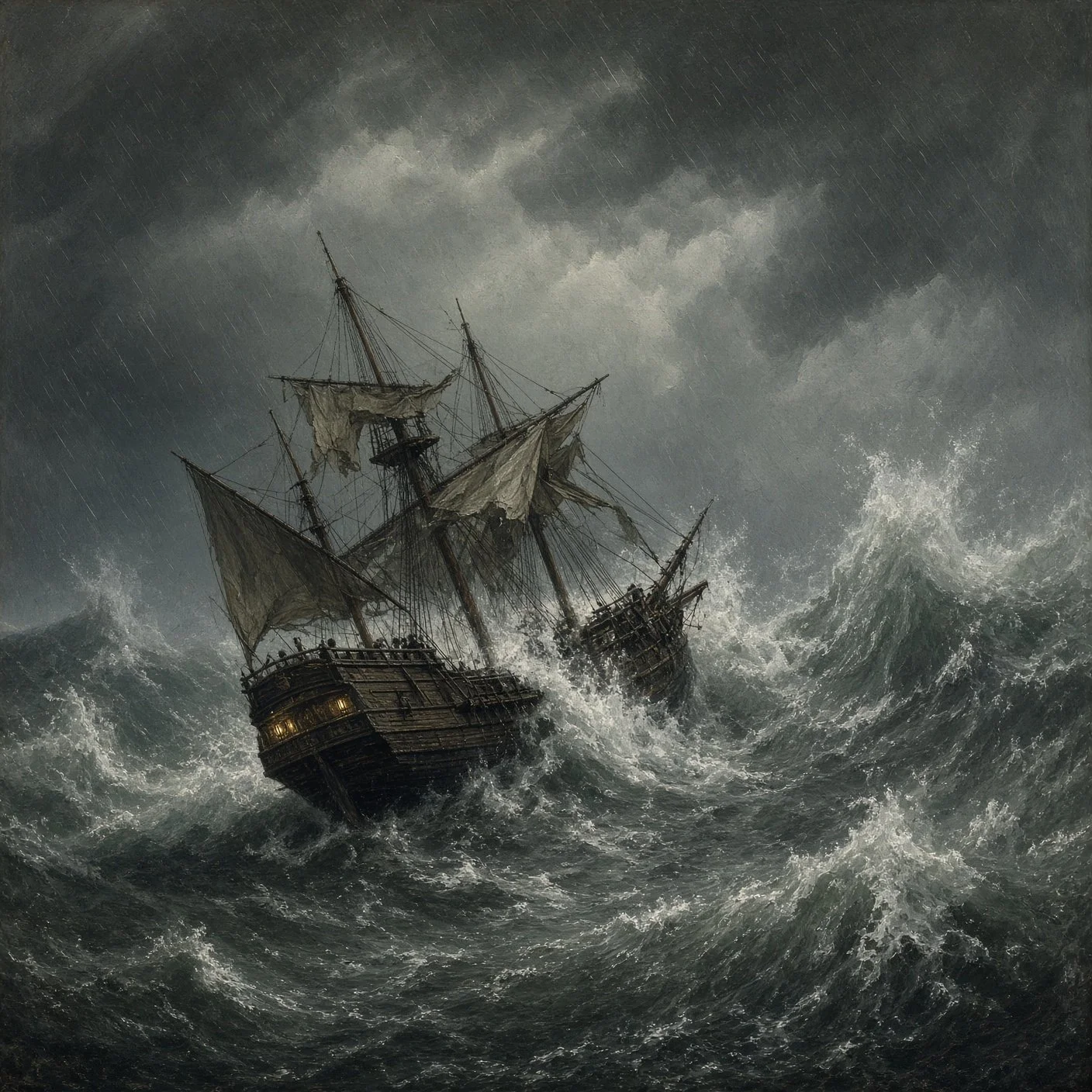
The Atlantic did not welcome them. For weeks the weather turned mean. Waves hammered the hull. The ship had to lie ahull in storms, sails down, just trying not to break apart. The main mast broke at one point and they lacked proper tools to repair it. Below decks it was damp, dark, and close. People were sick. Tempers frayed. Two died before they ever saw land. When Cape Cod finally appeared in November, it wasn’t the Virginia they’d aimed for. Winter was upon them, and they were exhausted.
That’s the voyage.
But, in one of those storms, a young man named John Howland came up through the gratings. He was a manservant to John Carver—not a captain, not a minister, just a “lusty young man,” as William Bradford later put it. The ship rolled in the storm. Howland went over the side. No one initially knew he went over.
Bradford wrote that it pleased God he caught the topsail halyards trailing in the water. The rope ran out. Howland went under, fathoms down, and still held on. They hauled him to the surface and got him back aboard with a boat hook. He was sick after it. Then he lived.
He was one of the signers of what would later be known as the Mayflower Compact. He survived that first winter when so many didn’t—about 45 of the 102 passengers were gone by spring. He married Elizabeth Tilley, who’d lost her own parents in Plymouth. They had ten children, then a small army of grandchildren. From that one household came one of the largest Mayflower family lines in America.
If that rope had slipped, a lot of later lives simply wouldn’t exist.
Three U.S. presidents come down from John and Elizabeth: Franklin D. Roosevelt, George H.W. Bush, and George W. Bush. So do poets who taught America how to hear herself—Ralph Waldo Emerson and Henry Wadsworth Longfellow. Phillips Brooks, who wrote “O Little Town of Bethlehem,” is in that line. So are names people know from screens and books: Humphrey Bogart, the Baldwin brothers, Christopher Lloyd, Dr. Benjamin Spock. First ladies and public servants show up in the same tree. Historians talk about millions of living descendants. The famous ones are only the ones we recognize.
That’s a strange thought for a church blog, and I mean it that way. I’m not saying God needed celebrities. I’m saying one ordinary life, almost lost in a September crossing, became a root system. Words, laws, hymns, families, and public years we take for granted grew out of a man who was just trying not to drown.
John Howland never saw that. He couldn’t have. He came up coughing, lived as a “profitable member both in church and commonwealth,” raised his kids, and died an old man in Plymouth. He didn’t know what his grip would mean.
Most of us won’t either.
We live in smaller storms. We hold a job, keep a promise, sit with somebody, stay when leaving would be easier. We don’t get a chart of the people who will exist, or believe, or lead because we didn’t let go. Paul told the church in Corinth something that still fits a wet deck and an ordinary Tuesday: “Always give yourselves fully to the work of the Lord, because you know that your labor in the Lord is not in vain.” Read that again. Think on that for a minute. Howland didn’t have those words in his pocket. He just caught the rope. The fruit came later, farther out than he could see.
So as this September turns toward fall, maybe that’s the word. The crossing is hard. The ship rolls. Somebody is always closer to the rail than they look. Hold what you’ve been given. You may never see the shoreline your life is heading toward—and you don’t have to. John Howland didn’t.
And a lot of the world, quietly, is different because he did.
You truly matter, have a blessed week!
~ Charlie