Empires of Force or a Kingdom of Love? Lessons from Napoleon’s Horse
Hey there,
During a deployment to the UAE in 2021, on a rare day off, I had the chance to get away and visit the Louvre Museum in Abu Dhabi. I’ve now been blessed to walk through both the original Louvre in Paris and its stunning sister museum on Saadiyat Island—the only branch of the Louvre outside of France. The Abu Dhabi location, with its massive white dome floating above the water and sunlight filtering through like a giant lantern, feels like stepping into another world—especially when you’re coming out of the desert heat and military routine.
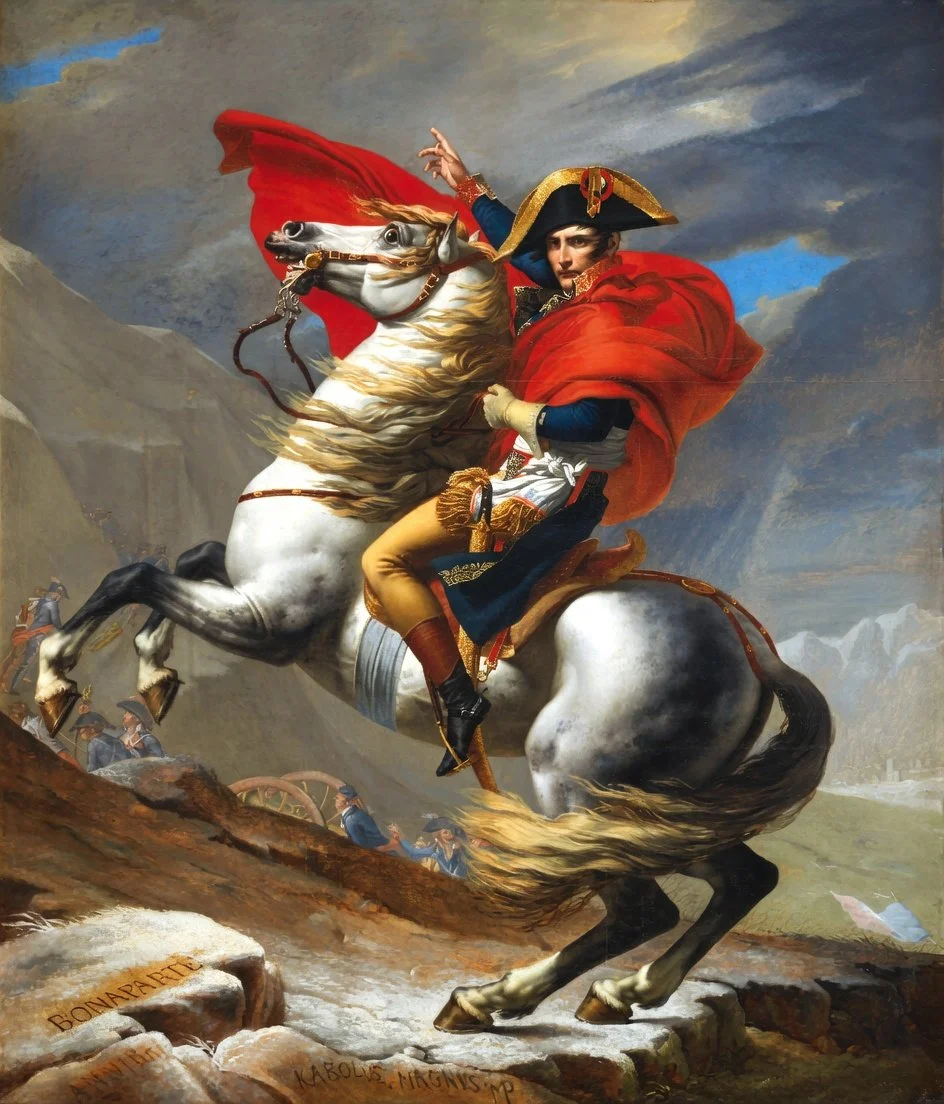
On display, while I was in country, was one of my favorite paintings: Jacques-Louis David’s Napoleon Crossing the Alps. It’s the one with Napoleon displayed—larger than life—on a powerful rearing white horse, crimson cape billowing in the wind, one hand dramatically pointing forward as if he were commanding destiny itself through the stormy mountains. It’s the ultimate image of human ambition, military genius, and raw power.
There I was, thousands of miles from home, but I couldn’t help but think about the man the painting glorifies. Years later, exiled on the island of Saint Helena and reflecting on his fallen empire, Napoleon reportedly said these striking words:
“I know men; and I tell you that Jesus Christ is no mere man. Between Him and every other person in the world there is no possible term of comparison. Alexander, Caesar, Charlemagne, and I myself have founded empires; but upon what do these creations of our genius depend? Upon force. Jesus alone founded His empire upon love; and to this very day millions would die for Him.”
He also marveled: “I marvel that whereas the ambitious dreams of myself, Caesar, and Alexander should have vanished into thin air, a Judean peasant, Jesus, should be able to stretch His hands across the destinies of men and nations.”
Napoleon built with armies, strategy, charisma, and force. His empire rose fast and collapsed faster. The same was true for Alexander the Great and Julius Caesar. Their grand dreams eventually vanished.
But Jesus—born in a manger, raised in obscurity, with no army, no wealth, and no political power—built something that has endured for over 2,000 years. He didn’t conquer with the sword. He conquered with love.
Jesus Himself made this distinction clear when He stood before Pilate:
John 18:36 — “My kingdom is not of this world. If it were, my servants would fight to prevent my arrest by the Jewish leaders. But now my kingdom is from another place.”
The Apostle Paul put it even more powerfully:
1 Corinthians 1:25 — “For the foolishness of God is wiser than human wisdom, and the weakness of God is stronger than human strength.”
And perhaps the clearest picture of all is found in Philippians 2:
“Who, being in very nature God, did not consider equality with God something to be used to his own advantage; rather, he made himself nothing by taking the very nature of a servant… he humbled himself by becoming obedient to death—even death on a cross! Therefore God exalted him to the highest place…” (Philippians 2:6-9)
Napoleon reached for the highest place and lost everything. Jesus willingly went to the lowest place—and was given all authority in heaven and on earth.
We live in a world that still celebrates the “Napoleon” approach: climb higher, push harder, build your own empire through force, influence, or self-promotion. We can even do this in Christian ministry—chasing bigger platforms, larger church attendance numbers, or personal recognition.
But Jesus invites us into a different kind of kingdom. One built on sacrificial love, humility, and service. His hands are still stretched out today—not to grasp power, but to offer grace, forgiveness, and new life through Him.
So the question for each of us is simple: What kind of empire am I trying to build with my life? Will I trust the way of force… or the way of the cross?
(And who knows — maybe Napoleon’s horse was the one who finally realized the whole dramatic ride wasn’t going to last. Jesus, on the other hand, is still carrying people forward two thousand years later.)
~ Charlie